
Contract requirements
9 minutes readSpecialty Contractor Insurance
What Homebuilders Actually Require From Their Subcontractors, and Why Most Policies Come Up Short
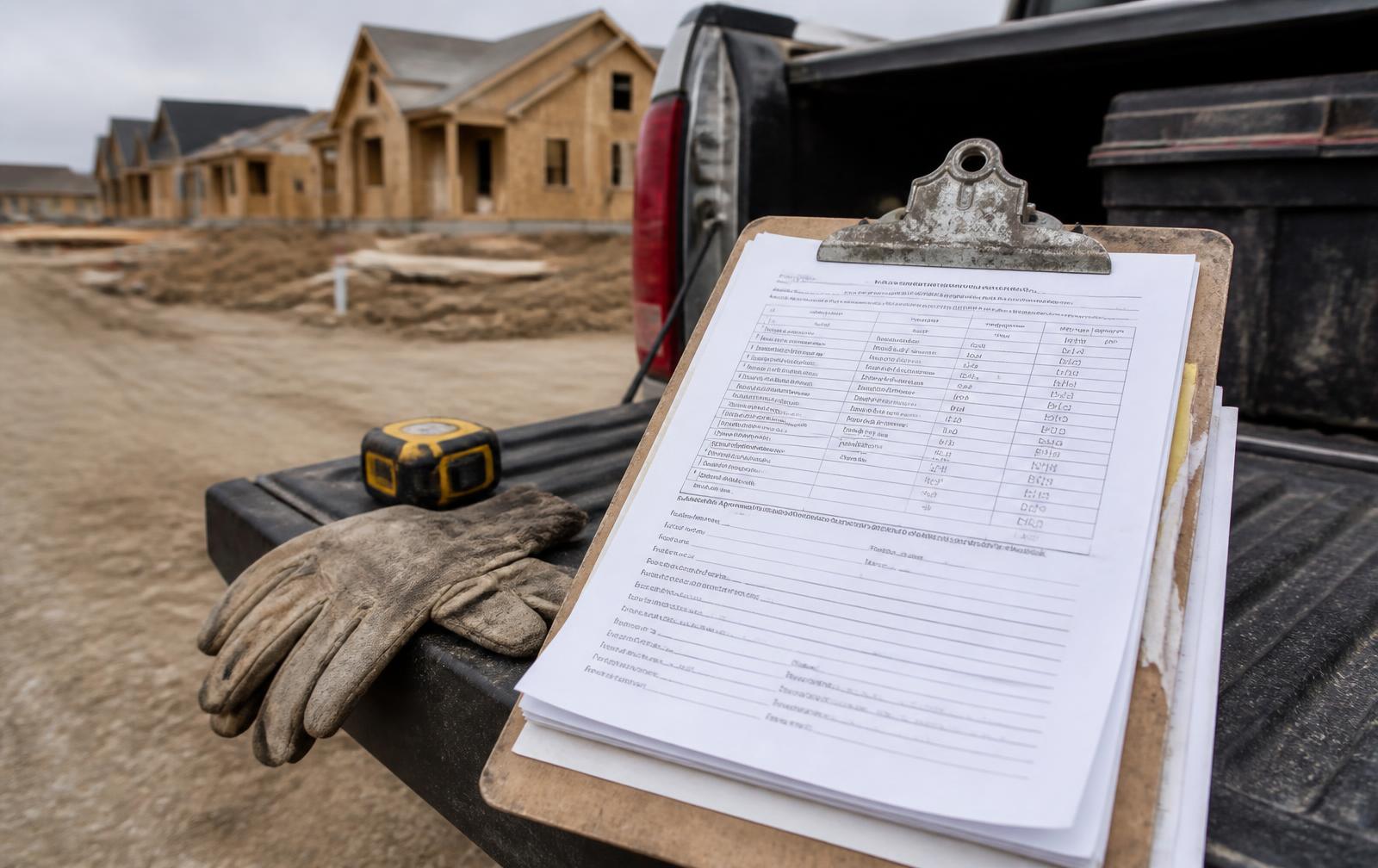
The call usually comes on a Thursday. The crew is scheduled to start Monday, the certificate went in a week ago, and the builder’s risk department has just rejected it. Nobody at the builder can explain the rejection in terms that help, because the person sending the email is working from a checklist rather than from a policy. Your agent says the certificate is correct. The builder says it is not. Both are right, which is the confusing part.
A certificate of insurance is evidence of coverage. It is not coverage. When a builder rejects one, the problem is almost never the certificate. It is that the policy behind the certificate does not contain what the builder’s schedule requires, and no amount of reissuing the document changes that.
What follows is how to read one of those schedules, which three items cause most of the rejections, and the one problem that cannot be solved with an endorsement.
Why close enough is not a category
National builders publish standardized insurance requirement schedules. The person reviewing your certificate compares it line by line against that schedule and either approves or rejects. They are not evaluating whether your coverage is adequate in any general sense. They are checking boxes, and a missing box is a rejection regardless of how well insured you actually are.
That sounds bureaucratic, and it is. There is a reason behind it. The builder is trying to make certain that when a defect claim arrives eight years from now, a policy responds and it is not theirs. Every line in the schedule exists because at some point a claim went badly for the lack of it.
Reading the schedule, line by line
Most schedules contain the same eight or nine requirements in roughly this order.
- Commercial general liability, minimum limits
Usually $1,000,000 per occurrence and $2,000,000 general aggregate, higher on some builders. Check the aggregate structure as well as the number, which is item four below.
- Additional insured, ongoing and completed operations
The one that fails most often. Your policy needs an endorsement granting additional insured status for ongoing operations and a grant extending that status to completed operations, either as a combined form or as two separate ones. Many blanket additional insured endorsements cover ongoing operations only. On a defect claim that surfaces after the home closes, ongoing-operations-only coverage does nothing for the builder, which is the exact scenario they wrote the requirement for.
To check it, look at the endorsement schedule in your policy rather than at the certificate.
- Primary and non-contributory
Your policy pays first and does not seek contribution from the builder’s policy. Without it, your carrier can argue that the builder’s coverage shares the loss, producing exactly the dispute the requirement exists to prevent. This has to be an endorsement. Typed onto a certificate it means nothing.
- Per-project aggregate
Without it, your general aggregate is a single pool covering every job you touch in the policy year. The builder is asking you to dedicate a fresh aggregate to their project so that a bad job somewhere else cannot exhaust the limit protecting their homes.
- Waiver of subrogation
Your carrier gives up its right to recover from the builder after paying a claim. Some carriers add it by endorsement at no charge, some charge for it, and a few will not do it. Confirm which applies to you.
- Umbrella or excess, following form
The limit is the easy part. The requirement is that the umbrella sits above the correct underlying policies and follows their terms. An umbrella that excludes something your primary covers is a gap in the middle of the tower.
- Workers compensation and employers liability
Statutory workers compensation plus employers liability at the stated limits, and in most schedules a waiver of subrogation in the builder’s favor.
- Commercial auto
Usually a combined single limit covering owned, hired, and non-owned vehicles, with the builder added as an additional insured.
- Notice of cancellation
The builder wants notice if your coverage goes away. Carrier practice varies, and the certificate language has to match what the policy actually allows rather than what the schedule asks for.
The three that cause most rejections
If you fix nothing else, fix these.
- Additional insured status that does not extend to completed operations
- A missing primary and non-contributory endorsement
- No per-project aggregate
These account for the large majority of the rejections we see, and all three are policy problems rather than paperwork problems.
The one that cannot be fixed with an endorsement
There is a fourth problem, and it is worse than the other three because no endorsement solves it. A general liability policy that excludes residential new construction.
Tract home exclusions, subdivision exclusions, unit count caps, and new construction versus remodel distinctions are common on contractor general liability policies, and they usually live on endorsements the insured has never read. If your policy excludes the work, the certificate is not the problem and revising it will not help. That is a placement problem, and it generally means finding a different market.
What to send your agent
When a schedule arrives, send four things rather than asking whether you are covered.
- The complete insurance requirement schedule, every page
- The subcontract agreement, particularly the indemnity article
- Your complete current policies including every endorsement, not the declarations page
- The states involved and your approximate annual unit volume
The last one matters more than it looks. Carrier appetite in this class is driven by geography and volume as much as by anything about how you run the business.
Timing
Fixing a policy takes longer than fixing a document. An endorsement request runs from a few days to a couple of weeks depending on the carrier. Moving a policy because of a residential exclusion runs weeks and sometimes longer, since it usually means going to the excess and surplus lines market.
The practical implication is that the time to read a builder’s schedule is before you sign the subcontract, not the week before the crew mobilizes. Contractors who send the schedule to their agent at bid stage almost never have this problem. Contractors who send it after a rejection almost always do.
The short version
A certificate is evidence, not coverage. Builders reject certificates when the policy behind them lacks something in the schedule, and the three usual culprits are completed operations additional insured status, primary and non-contributory, and per-project aggregate. The one that cannot be endorsed away is a residential exclusion on the general liability policy itself. Read the schedule at bid, not at mobilization.