
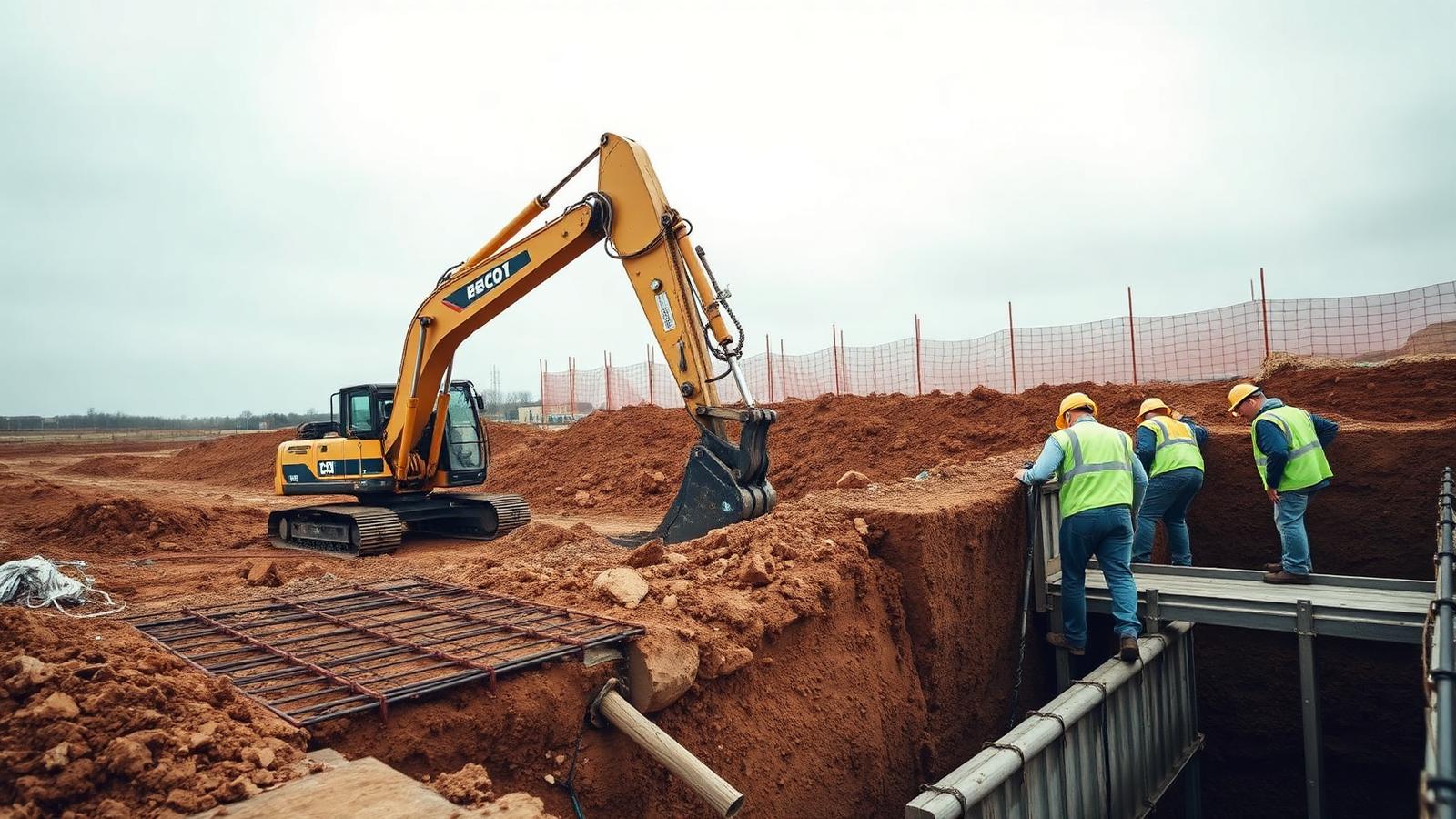
Sitework, Excavation, and Concrete Contractor Insurance
Sitework and concrete are often performed by the same firm, and they share a general liability problem that sets them apart from the other trades. Much of what goes wrong is damage to the earth itself, or to what is buried in it, and standard policies handle that badly.
They also share the distinction of carrying the two highest-severity events in construction. A trench collapse and an underground utility strike are each capable of producing a fatality, and both attract regulatory attention alongside the claim.
The rest of the exposure splits along familiar lines. Sitework is about what is under the ground and what happens to adjacent property. Concrete is about what gets poured, how it is placed, and whether it holds up across the years construction defect claims take to arrive.
Coverage gaps
Where coverage goes wrong
Sitework and excavation
Underground utility strikes. The first thing an adjuster asks for is the one-call ticket. A documented locate request changes the entire conversation. Without one, the claim becomes an argument about your own negligence rather than about a mismarked line, and the damages include the utility's repair, service interruption to everyone downstream, and sometimes a fatality.
Trench collapse. The highest-severity workers compensation event in construction, with regulatory involvement close to guaranteed and employers liability exposure sitting alongside the compensation claim.
Soil movement and adjacent property. Excavating next to an existing structure can cause settlement and cracking in a building you never touched. Subsidence and earth movement exclusions on general liability policies routinely remove exactly this exposure.
Dewatering and stormwater discharge. Pumping water off a site and discharging it is a pollution exposure. So is sediment leaving the site. The general liability pollution exclusion is broad enough to capture both.
Heavy equipment. Excavators, dozers, and loaders belong on a scheduled inland marine form at realistic values, not on a tools and equipment floater sized for hand tools. Rented and leased units need separate attention, since rental agreements assign responsibility in ways owners do not always read.
Hauling and off-road equipment. Machines that travel between sites fall across the line between commercial auto and general liability, and the gap between those two policies is where claims get denied.
Concrete
Formwork and shoring collapse. A failure during a pour is a catastrophic event with both property damage and injury exposure, and the engineering of the formwork is a question that leads directly toward professional liability.
Pumping and boom operations. Whether the pump is owned or subcontracted determines which policy responds when a boom contacts a power line or a structure. Worth confirming in advance rather than in the aftermath.
Cold joints, slab defects, and construction defect. Concrete problems surface years later, which puts this work squarely in the long-tail defect category with all the completed operations implications that carries.
Washout and slurry discharge. Concrete washout is an environmental compliance issue and a pollution exposure, and it is one regulators actively watch.
Silica exposure. Cutting, grinding, and drilling produce respirable crystalline silica, and underwriters have started asking about controls. It is an emerging long-tail health exposure that is easier to get ahead of now than to defend later.
Flatwork versus structural. Carrier appetite splits here. A contractor moving from driveways and slabs into structural concrete has changed their risk profile considerably more than their premium may reflect.
Both sides of this work run into subsidence and earth movement exclusions, damage to work in progress, and general liability policies written for a general trades contractor that quietly exclude exactly this scope.
Program
Coverages that matter most
- General liability, with subsidence, earth movement, underground property damage, and pollution wording all confirmed rather than assumed
- Contractors pollution liability, which for this work is close to essential
- Workers compensation, where trench safety documentation affects both rate and availability
- Scheduled inland marine on heavy equipment, including rented and leased units
- Commercial auto covering hauling operations
- Umbrella sized to the severity of the exposure rather than to the size of the firm
- Professional liability where the contractor engineers formwork, shoring, or excavation sequencing
Underwriting
Classification and payroll
Excavation, grading, concrete flatwork, and structural concrete carry different workers compensation rates, and firms performing several of them need the payroll split documented.
Operators, laborers, and finishers are typically classified differently, and equipment operator payroll in particular is often reported at the wrong rate.
Because this trade tends to be first on a site and last to be paid, subcontracted hauling and equipment rental with operator both create classification questions worth resolving before the audit finds them.
Contract requirements
Sitework contractors are frequently first on the job, which means the general contractor's requirements are in place before anything else is. Expect the full schedule, plus specific attention to pollution coverage, since many general contractors now require contractors pollution liability from site trades explicitly. On projects adjacent to existing structures, expect requirements around monitoring and sometimes a separate bond.
Claim scenarios
How these claims actually happen
A crew strikes an unmarked fiber line during trenching. The line serves a hospital and two commercial buildings. The utility's physical repair is modest. The service interruption claim is not. Whether the contractor documented the one-call ticket determines how the next twelve months go.
An excavation adjacent to a century-old commercial building causes settlement, and cracking appears in the neighboring structure two months after backfill. The contractor's general liability contains an earth movement exclusion, and the claim proceeds against the contractor while coverage is litigated separately.
A concrete pump boom contacts an overhead service line. The pump was subcontracted, the operator worked for the pump company, and the setup was directed by the concrete contractor's foreman. Three parties, three policies, and the answer sits in contracts nobody read that morning.
Questions
Frequently asked questions
- Does my general liability cover damage to underground utilities?
- Sometimes, and it depends heavily on wording and on whether you documented the locate request. Some policies exclude underground property damage outright. Worth confirming before the next job rather than after the next strike.
- What is an earth movement exclusion, and why does it matter to me?
- It removes damage caused by movement of the earth, which for an excavation contractor can eliminate coverage for the most likely claim you will ever have. Buy-backs and specialty forms exist, and this is one of the first things we look at on a submission in this class.
- Do I need contractors pollution liability?
- For this work, usually yes. Dewatering discharge, sediment, fuel, and concrete washout are all pollution events under a standard general liability policy's definition, and the exclusion is broad enough to catch them.
- Is my heavy equipment covered on my general liability policy?
- No. Equipment is an inland marine question, and it needs realistic scheduled values plus specific attention to rented and leased units.
- Should I be worried about silica?
- It is worth getting ahead of. Controls, documentation, and monitoring are what underwriters are beginning to ask about, and it is a long-tail health exposure that is far easier to address now than to defend later.
Let’s look at what you have
Send us your current policy, including every endorsement, and tell us what your contracts require. We will tell you where the two do not line up. It costs nothing, and it does not obligate you to move anything.
Working with specialty trade contractors in all 50 states, at our best with firms between $500,000 and $20 million in annual revenue.
The information on this page is general in nature and is not a statement of coverage or a contract. All coverage is subject to policy terms, conditions, exclusions, and carrier underwriting. Availability varies by state, class of business, and individual risk.